Sunday, October 17, 2021

Something about Inlay (especially for Rigid Heddle Weavers)

I love playing with pick-up sticks, and I love the magic of inlay in all of its many variations (and there are many!).   For Rigid Heddle weavers, it's a relatively painless way to put geometric patterns and even more complex images into our woven projects - often only needing a pick-up stick (though sometimes multiple heddles are needed).

I've been having trouble finding a definitive definition of inlay, but Betty Linn Davenport has a pretty good one in her book Hands on Rigid Heddle Weaving.  To summarize, I've made a list of the characteristics that inlay usually exhibits:

Supplemental weft (maybe also supplemental warp?)

Discontinuous thread (usually doesn't go all the way from selvedge to selvedge)

Plain weave ground, usually (though twill is also used in multi-shaft weaving)

Woven in (not added later like embroidery)

Usually a heavier thread than the ground weft and the warp

Usually in a contrasting color/colors

Can be on a balanced weave or on a weft-faced weave


It includes:

Simple inlay, laid-in patterning, wrapped inlay, inlay with cut wefts, Theo Moorman technique, transparency, brocade, Swedish Krabba and Dukagång, Bhutanese Kushutara, Kutch supplemental weft patterns, and many other gorgeous ethnic and world fabric techniques for which I do not know the names.  

It probably also includes looped, twined, and knotted textural supplemental weft techniques like Boutonné, Flossa/Rya/Ghiordes knots, Soumak, and probably other techniques I’ve yet to discover!


And here are some resources that have inlay info and drafts and projects.

1.  Books that Heddlers might have:

  • Davenport, Betty Linn, Hands on Rigid Heddle Weaving, Interweave Press, 1987, pgs. 61-68. 
  • Davenport, Betty Linn, Textures and Patterns for the Rigid Heddle Loom, Revised Edition, 2008, pgs.19-25 
  • Mitchell, Syne, Inventive Weaving on a Little Loom, Storey Publishing, 2015, pgs.73-181, 212-215. 
  • Patrick, Jane, The Weaver’s Idea Book: Creative Cloth on a Rigid-Heddle Loom, Interweave Press, 2010, pgs. 108-113, 141-160.

2.  And other important weaving books that have inlay info:

  • Black, Mary E., New Key to Weaving, Macmillan Publishing Company, 1957 edition, pgs.  98-104, 117-147.
  • Dixon, Anne, The Handweaver's Pattern Directory, Interweave Press, 2007, pgs. 238-241. 

I haven't really explored my magazines yet, but the Handwoven magazine March/April 2017 is all about Scandinavian weaving - for inlay, try pages 14-15, 48-50, and 56-57. 

Eye Candy:
Norwegian Textile Letter

Warped for Good

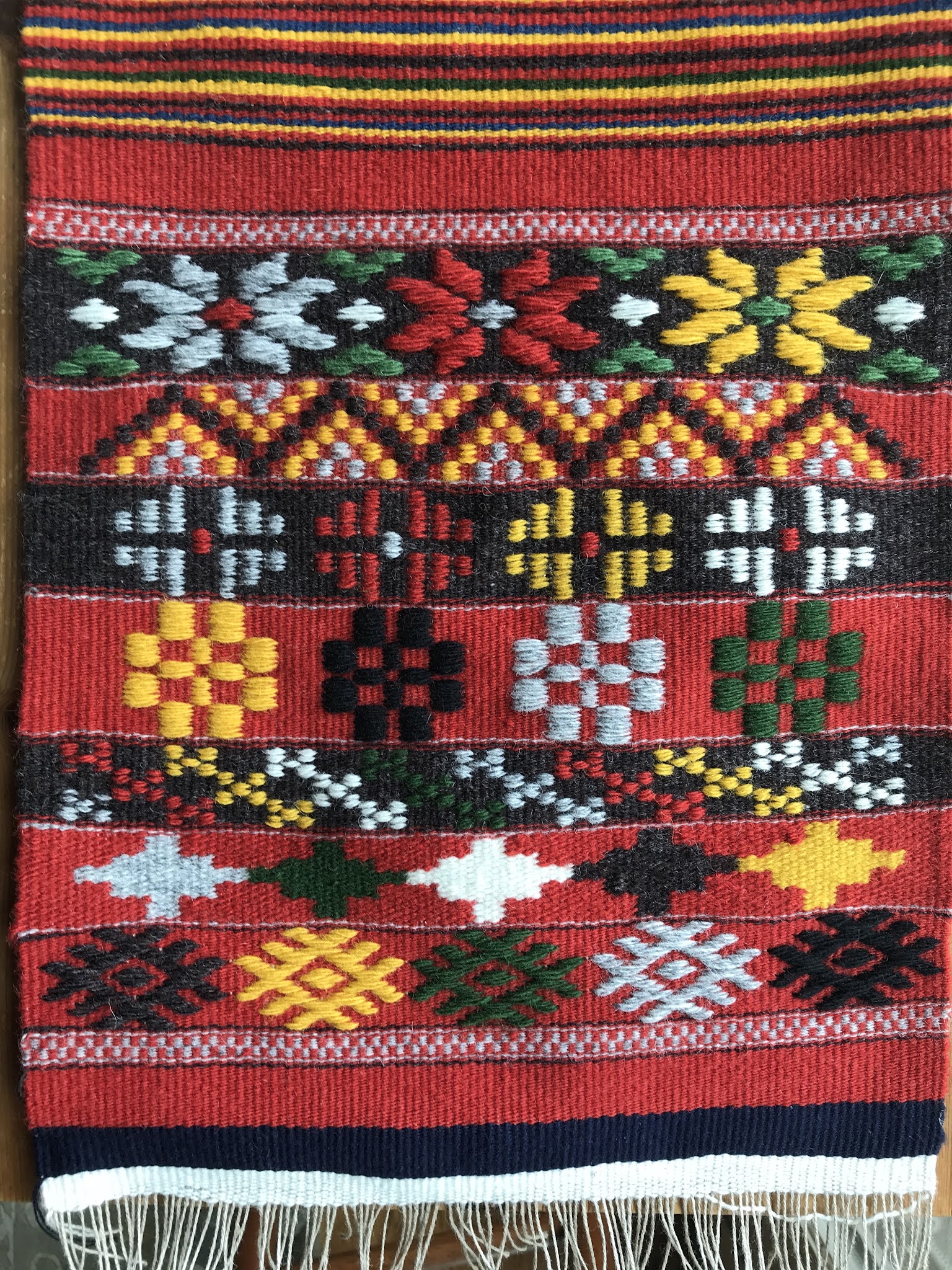
This is my sampler from a Joanna Hall class on Swedish Art Weaves - some done in class, some done later on my own.  From bottom to top, has Krabba, Rolokan, Halvkrabba, Monks Belt, Dukagång, more Halvkrabba, and more Krabba (playing with a larger scale on this one, to see if the floats are still manageable).  

Not all of these rows are inlay.  Rolokan is not an inlay - though it is a discontinuous weft, its wefts form part of the ground structure and so they are not supplemental wefts ( Rolokan is a tapestry weaving technique). 

Can Monks Belt be considered inlay?  I don't know.  In this sampler, it uses a discontinuous weft pattern that does float over the plain weave ground like the other inlays, so maybe?  

Sampler is weft faced, uses Borgs Faro single ply wool weft and Bockens 16/3 linen warp sett at 10 epi.  And a pick-up stick.  And the occasional heddle stick (for Monks Belt and Dukagång)


Saturday, October 9, 2021

Winter is coming! Well, Summer and Winter anyhow.

Quick and non-curated bibliography for my local structures study group - few annotations, very few links, very little attention to proper bibliographic format, but hey - it's a start!

Discoveries:  

Multiple variations - Brick treading/singles/traditional/alternating, and "O's/pairs/roseate/birdseye, and X's/pairs/hourglass, and Dukagang fashion 1 and 2/columns.  And then you can change the look of the pairs by starting the tabby with 2 instead of 1!  And then you can turn the draft.  And then there's polychrome!  Yikes!

It has a relation to Crackle, and Taquete, and Samitum, and Half Satin, and even Tied Overshot and more!  

1.  Handwoven Magazine 2006 to 2021 (the number in brackets at the end of a listing tells how many shafts are needed).  May/June 2006 is almost all summer/winter, and has a van der Hoogt "School for Weavers" section that was quite helpful to me.  If you need more, search for Handwoven Magazine Indexes and have a look at the earlier issues.  There's lots.

2021

Bauhaus Weaver Hand Towels. MA21, 50-52 (4)

Fishing for Compliments. SO21, 62-64 (8) 


2012-2020

Adventures in design: weaving upholstery fabric. SO15, 22-23

Both sides of summer and winter: linen placemats. JF16, 44-46 [7] 

Bread cloths. ND20, 40-42 [4]

Four blocks on four shafts: summer and winter towels. MJ13, 27-29 

Hail to the hostess bottle bags. SO16, 42-44 [6]

Inspired by color towels. MJ18, 48-49 [4]

Inspired vest. SO12, 48, 50-51 [8]

Spicy scarves. MJ14, 52-54 [8]

Starry sky placemats. SO16, 50-52 [4]

Stars & stripes picnic blanket. SO16, 34-36 [8]; errata MA18, 67 

Summer & winter squares. MJ20, 30-32 [6]

Summer and winter. SO16, 18-19

Summer and winter kitchen towels. MJ16, 38-40 [4]

Summer and winter silk scarf. MJ16, 46-48 [4]

Summer and winter spelled out. ND15, 20-21

Summer and winter with a twist polka-dot towels. JF15, 46-48 [8] 

Sunshine napkins and raffia placemats. MA12, 38-41 [2, 4]

Turning autumn towels. SO20, 61-63 [4]


2006-2011

Bookmarks and a Polychrome Challenge. MJ06:56–59 [8]

Color Gradations in Summer and Winter. MA11:60–61 [4]

Color Play in Summer & Winter. MJ10:38–39 [6, 4]

Farkle Game Bags in Summer and Winter. SO07:60–62 [8]

Fun and Functional: Turned Summer and Winter Towels. MJ06:52–55 [8]

A Run of Linen Runners on the Same Warp.  MJ05:52–55 [8]

School for Weavers: A Summer and Winter Family Reunion. MJ06:74–77

A Small Coverlet Is within Your Reach. ND11:62–63 [6]

Summer and Winter Polychrome—A Yarn’s Best Friend. SO10:58–59[8]

Summer and Winter Resources. MJ06:14 

A Summer Shawl.  MJ06:48–50 [8]

Technicolor Cloth.  MJ06:44–47 [4]

Warp Once, Weave Two Throws—or More!.  SO09:60–62 [6]

Winter, Spring, Summer, and Fall. MJ06:40–43 [4]


2.  A Weaver's Book of 8-Shaft Patterns.  Ed. Carol Strickler,  pgs. 145-161.
Has a lot about using a profile draft too.  And even though I took "Unlock the Block" (thanks Janet Dawson!) and had no trouble with the threading and the tie-up, the treadling substitutions made my brain hurt until I put it all up in Fiberworks.  (Some of us have to actually do a thing to understand it) Did the sheep in all the variations.  Fun.  Though the original still probably looks the best out of all the possibilities.

Don't have this one yet, but it looks good.

4.  The Best of Weaver's Summer & Winter Plus Ed. Madelyn van der Hoogt
A lot of projects for 10 shafts and up, but it does have 6 @ 8-shaft, 1 @ 5-shaft, 1 @ 6-shaft (turned), and 4 @ 4-shaft (with pick-up).  Also a lot of info on tied unit weaves.  Deep structures dive.

5.  New Key to Weaving.  Mary E Black,  chapter 9.

6.  Summer and Winter: A Weave for All Seasons.  Donna Sullivan (I'm putting this in here, but hoping it is at the guild library as it's a bit pricey everywhere.)

7.  The Complete Book of Drafting.  Madelyn van der Hoogt

8.  Best of Handwoven: Summer and Winter eBook - these are all projects from Handwoven magazines, but a choice if you don't have a subscription.

9.  And a video download Weaving Summer and Winter  Madelyn van der Hoogt 

10.  A Handweaver's Pattern Book.  Marguerite Porter Davison, Chapter XX Summer and Winter

11.  Learning to Weave.  Deborah Chandler,  Lesson 14 Summer and Winter.

12.  And if you took Janet Dawson's "Unlock the Block" class, she has given us a few pages of lovely Summer and Winter essentials info including threading keys and treadling keys.
As well as a gorgeous draft in Towelpalooza 2020!

13.  And of course, if you're a Rigid Heddle weaver,  I have a blog post about that!

My take on the sheep draft from Strickler (playing with the variations).  
From top to bottom - bricks,
 o pairs, x pairs,
columns 1 and columns 2.


Saturday, May 15, 2021

Perfectly Wonderful Plain Weave! And some first thoughts on color and pattern too.

 This post is a work in progress.  Beginning with just a list of starting points for weavers, and hope to add written details, photos, and maybe links as time goes on.

The list:

1.  Let the yarn do the work - 

  • Warp and weft are both a self-patterning yarn.
  • Warp is a fancy/self-patterning yarn and weft is a plain yarn
  • Warp is a plain yarn and weft is a fancy/self-patterning yarn

2.  Let the yarn work, but add some stripes - planned or random, symmetrical or asymmetrical
  • Warp has stripes but weft is plain
  • Warp is plain but weft has stripes 
  • Warp and weft are both striped!  (Think checks and plaids, or just borders on top/bottom/sides, or a grid on a plain field)

3.  Color and weave effects - plain yarn in a dark/light pattern in warp and weft
  • Houndstooth
  • Log Cabin

4.  Yarn special effects - in warp or weft or both, regular pattern or random
  • Use a thicker yarn, or thick and thin yarn, or structured yarn (eyelash, boucle, beehive, ribbon, etc.).  If using for warp, remember to test for strength and stretch and stickiness and abrasion resistance (rubbing off in the holes/slots).  And most important - will it fit through the space in the heddle reed (slots are bigger but not infinite!).  Some flashy textured yarns are best as weft only.
  • Use thin strips of fabric (light weigh for drape or heavy weight for placemats, rugs, etc)(probably best as a weft)
  • Use thrums (small lengths of leftover yarn) and overhand knot them together as you wind onto bobbin or stick.  Let the knots and tails become a textural design element.

5.  And more!  Is there more?  What am I forgetting?

  • Try some fulling (washing more vigorously for thickness) or even hard-fulling/felting
  • Leave a gap (use a cardboard spacer in the weft)(skip slots/holes in the warp) and let the yarns shift (or lightly felt them to hold the openings in place). 


Part Two - Colors

My main advice on this is to look everywhere and steal like an artist.  

If you see a great color pattern somewhere - can you get similar color yarns and translate that to plain weave on your Rigid Heddle?

If you see a great pattern somewhere but don't like the colors - can you use that pattern in plain weave and translate it to colors that you love?


I'll be back later.

Friday, April 16, 2021

Waffle-ing!

Here are some thoughts about waffle weave, which happens to be one of my favorites.  There's just something charming about the way it shrinks and bubbles and makes little pockets and, well, waffles!

My local weave structures study group is doing waffle weave just now (Yeah, and it's all my fault.  Someone asked if anyone else had anything they wanted to do and I said I liked waffle weave and the next thing I knew . . . ).  

Anyhow, I thought I would try to be a little organized about the whole thing.  

So here's my table of contents!

1.  What the heck can waffle weave be used for?

2.  Of Setts and Shrinkage

3.  Going wild with color (or not)

4. Yikes!  I almost forgot to talk about yarns!

5.  Resources (as of April 2021 anyhow)

6.  Especially for Rigid Heddlers!


1.  What the heck can waffle weave be used for?

  • towels of any kind or size (fingertip towels to beach towels to kitchen towels to spa towels), plus washcloths, spa cloths, dishcloths
  • placemats and table runners (you might want to pick a shallow draft and/or thinner yarns so your glassware doesn't dip into the waffle and take a dive)
  • hotpads, microwave pads (cotton only), casserole cozies, basket liners (to cushion breads, rolls, muffins, fresh fruit)
  • blankets, throws, pillow covers
  • scarves, shawls, wraps. ruanas
  • yardage for garments - shirts (remember cozy thermal shirts - yeah, waffle weave), bathrobes, jackets
  • rugs!

2.  Of Setts and Shrinkage
When you wet finish it - it shrinks.  
(this photo is hemp (2ply neutral and 3ply color) in a little 3 shaft-ish waffle weave done on a rigid heddle loom)

It shrinks a lot.  In both directions.   

Lunatic Fringe 10/2 cotton @ 28 epi (24 epi for the plain weave) - all 8 shaft drafts on the exact same warp, with the same washer and dryer treatment (and many years of use) - from biggest to smallest -
plain weave, twill, waffle with tie down (like Strickler #512), and full waffle (like Strickler #511)


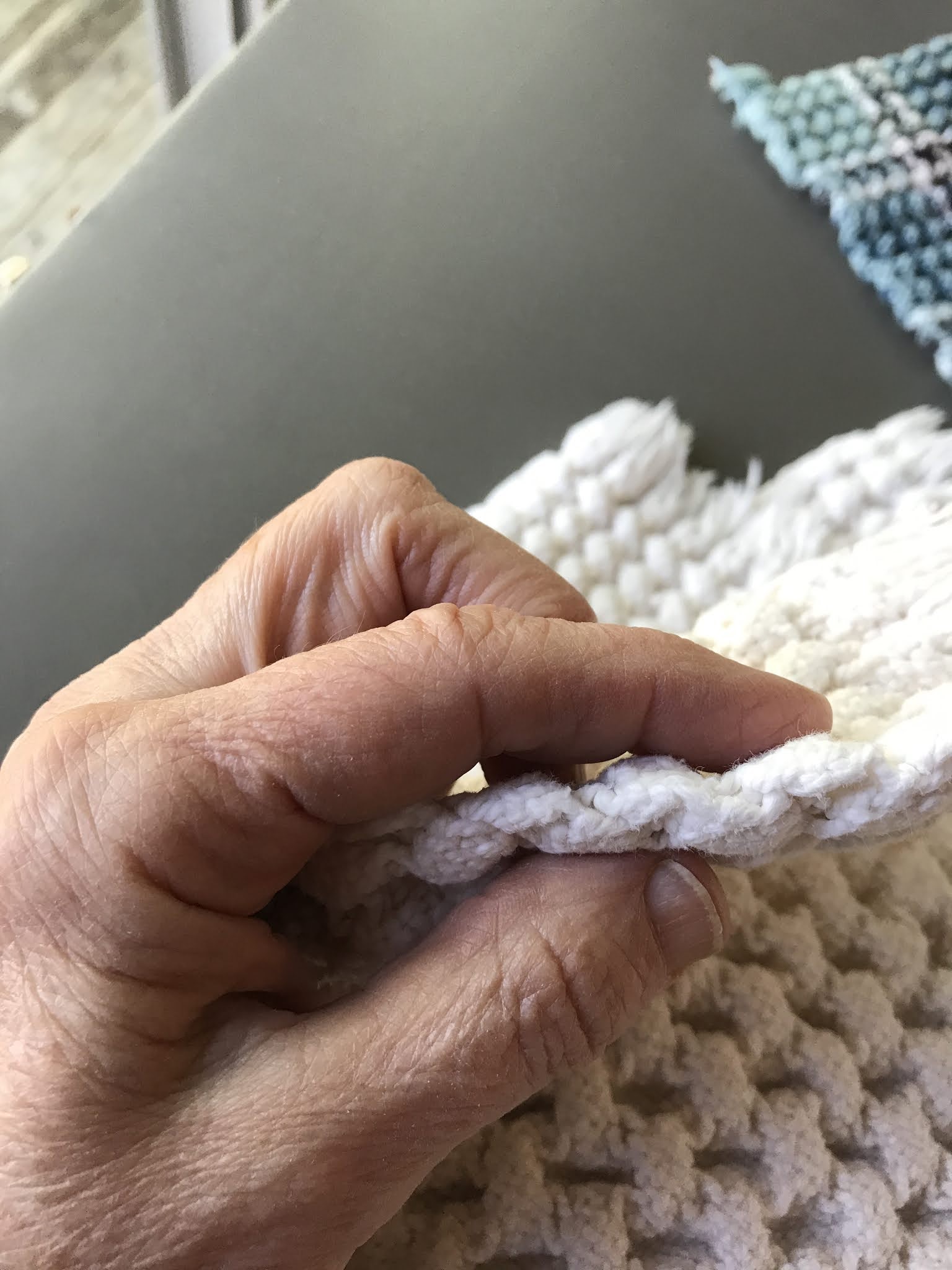
Of course what it loses in length and width it gains in depth/thickness (cozy blankets)(thirsty towels).  
These are not folded over!  This is the actual edge-on view of these towels!  Cool, eh?

Madelyn van der Hoogt suggests using a twill spacing on the sett.  Check out some waffle weave patterns and take advice from those designers.  And then sample and wet finish your sample (wash as you intend the finished project to be washed) - especially do the sample if the finished size is really important - because your yarn might be different, or your "beat" in weaving might be different.  
Next month I'll post any discoveries that my study group finds.


3.  Going wild with color (or not)
  • This structure is lovely with stripes to bring out the edges and the pockets (see Teaching with Towels for some color ideas).  And here's a 7shaft sample I wove in a Janet Dawson class with her draft and her own color design.  I love the way the white highlights the peaks and the brown deepens the valleys on the stripes.

  • In a color gamp (the Lunatic Fringe kit has 2 - 8shaft waffle weave patterns in the instruction packet - https://lunaticfringeyarns.com/product/dinner-kit/ ) the full waffle (first photo) and the waffle with little tie downs in the middle of the waffle (second photo)

    And here's a closeup of those tie downs - those little dots in the center mean that the waffle pocket doesn't get quite as deep so it doesn't shrink quite as much.

  • And just with a lovely soothing solid color - seen here on a Sue Willingham cotton bath towel (7shaft?).  (She sells these (and more) at https://willingham-weavery.square.site if you're interested).  


4. Yikes!  I almost forgot to talk about yarns!

Cotton, cottolin, linen, hemp, tencel, wool, fabric strips, and probably anything else that's appropriate to your project! (no acrylics or nylons or other manufactured yarns in the kitchen please - they might melt!) 

In Handwoven Magazine Jan/Feb 2013, Laura Fry has a brief comparison of Lamb's Pride Worsted from Brown Sheep Company and Pony Worsted from Henry's Attic (both wools) and how they perform in waffle weave after fulling the cloth.  Short but really interesting.

And the different fibers probably all shrink at different rates - we'll find out!


5.  Resources (as of April 2021 anyhow) - sorry, these are in no particular order at this time.

6.  Especially for Rigid Heddlers!

Friday, May 31, 2013

Spinning Silk Bibliography

April 2021 - I have to change many of these links (Interweave no longer exists as such but some of these might be found in Long Thread Media)


When I did the knitting with Mawata demo for my spinning group, I put together a bibliography that I thought I might as well share with all of you.  These are just the resources that I know about at this time - I'm sure there's more out there!

Spinning Silk Bibliography (with emphasis on Mawata, but a little of everything else, too)

1.  Spinning Silk: Sensous, Successful Yarns from Luxurious Silk (DVD) Sara Lamb
Great process video – she spins (and you get to watch closeups and spin along with her) the whole time she is talking about what she’s doing.  Excellent for learning/practicing.  Not a great source for mawata spinning (she even says that she doesn’t like to spin mawata) but fabulous for everything else about silk spinning.

2.  Spinning Luxury Fibers (DVD) Judith MacKenzie – 3 disc set - disc one is all about silk
Always relaxing and fun to learn from Judith (a wealth of lore and a lifetime of experience) – includes a great section on spinning mawata.

3.  Spin-Off Presents: All About Silk (eBook)
Silkworm lore (wild and cultivated), mawata spinning and dyeing, spinning fat silk singles, spinning for weaving, spinning embroidery thread

4.  A Guide to Spinning Silk Fibers + Free Knitting, Weaving, Crochet, and Embroidery Projects Using Silk Fiber (free eBook)
Spinning silk for knitting (hat project) and weaving (pillow project) in the same colorway, spinning and chain ply/Navajo ply for crochet and beaded rope (necklace/bracelet) project, spinning embroidery thread and small embroidered badge/medal project.

5.  Spinning Silk Hankies photo tutorial

7.  Spinning Silk caps (like mawata, only a different shape) tutorial

8.  Spin-Off magazine
Winter 1999 “Wild Silks Part One”
Spring 2000 “Wild Silks Part Two”
Summer 2001 “Learn to Spin Silk with Sara Lamb”

9. YouTube (only one of many available videos – this one is recommended by Blue Moon Fiber Arts and WormSpit)

10.  A great reference page on spinning all kinds of silk preparations, with info on spinning mawata (though I predraft more than they do) and links to more videos!
http://www.treenwaysilks.com/kc-spin.php

11.  Silkworm rancher and silk reeler/weaver – tons of info about the dear wee beasties that make silk (domestic and wild) as well as tons of info on how to process their product.

I have not used this book, nor do I have it yet, but include it because it is referenced by many who work with silk (especially dyers). 
Her current website (below) has mostly fabrics and yarns and natural dyes, including kits for dying silk, plus organically raised in the US “peace silk” cocoons (no silkworms were killed, but were instead allowed to hatch out).

Shopping: (these are just a few of my current favorites – mostly local Pacific Northwest-ish vendors, though the silk probably mostly comes from China or India)

above is the link for mawatas, but she also has lots of silk top and silk blends (below)
in lots of colorways 

Great source of silk and silk lore, plus beautiful hand-dyed colors in fibers, yarns, silk ribbon, and kits.
Also undyed silk of all kinds (Bombyx, Tussah, Eri, Muga) in different preparations (sliver, bricks, noil, laps, etc., including undyed Bombyx mawata) as well as yummy blends (with camel, cashmere, yak, etc.)  http://www.treenwaysilks.com/productlist.php?category=16

source for undyed silk hankies (mawata)

http://weavingworks.com/
Seattle store with lots of spinning fibers including silks, blends, mawata, noil, etc. – natural and dyed
https://weavingworks.com/blogs/news/spinning-silk-hankies

Monday, May 20, 2013

Of Swans and Springtime, of Love and Migration

Lara is gone again.
But wait, you need to hear the story from the very beginning! 
We have a swan.  

Or the swan has us, it's hard to say how these things go.  At any rate, his name is Boris, and he lives on the pond down on our wetland - he came with the property when we moved here 13 years ago (it was a condition of the sale that we take care of him - he's not a native, and so his wings are clipped and he is confined to our property - and we have to supplement his diet since he is unable to leave to look for food elsewhere).

And he is in love with a Canada Goose.
I figured this out some years ago when I saw them gently twining necks out on the pond!
Since he is Boris, we call her Lara.

He shares his food with her and he protects her while she eats (that puffed neck and head down posture is warning me to keep my distance or else!), 


he swims with her and takes romantic baths with her (splashing together in the pond),

and he walks in the orchard with her (he also has a pair of Mallard minions that follow him). 

There's only one problem - (cue up Lara's theme from Doctor Zhivago)
She migrates.
Every Spring and Fall, she stops by for a few weeks, but the urge to travel on must be strong and she always leaves.
Every Spring and Fall, when the skeins of geese fly by, he cocks his head and watches, looking for her, waiting for her.  

In the spring he builds huge nests to tempt her to stay.
He even sits on the nests to prove his willingness to co-parent with her!

but she always leaves, eventually.

People on the island have commented to me about seeing one large white goose in a flock of Canada Geese (swans and geese can produce offspring, but their offspring is infertile) and yes, we are just a little way south (80 miles or so) of a major snow goose and native swan winter habitat, so it could be a stray, but still, 
it makes us wonder.

Wednesday, May 15, 2013

The Problem with UFO April ~or~ "What I did Instead"

Well, honestly, April was not as good for UFO's as I had hoped!  This is what happened:

1.  The sun came out.
OK folks, this is the Pacific Northwest and when the sun comes out, the siren call of the garden is irresistible.


(please ignore the hundreds of volunteer kale plants that are about to smother everyone else.  They are destined for the salad bowl.)

2.  Hung out with the barn beasts.  And everyone.
It got too warm for the alpaca boys, so spent some time cooling them off.  


And collected brambles for the goats.  And took walks with the kitty.  And looked for tadpoles in the pond (still too early).  And did some birdwatching.
( a flock of 15 crossbills stopped by for a snack on their way to wherever they were going)


3.  Hurt my back.
Well, I thought I was taking it easy on the gardening, but there was a lot of remedial weeding (garden never got tucked in last fall, so the weeds took over) and I guess I overdid a bit (resulting in not being able to do the slightest bending, reaching, or twisting for about a week).  All better now.  I hope.

4.  Played guitar and banjo.
My dear husband and I are planning to attend a music retreat and I have not been playing much, so really had to put more time in (and get my calluses back!).

5.  Practiced spindling.
Thinking about going to the retreat made me look for extremely portable fiber projects to take along, and though I'm pretty confident on my spinning wheel, it's too much to bring to camp, and since I'm not very proficient with spindles, I watched Abby Franqemont's "Respect the Spindle: The Video" (Interweave Press) and played a little.  (the spindles are all Ed Jenkins Turkish Spindles)

The small spindle is 28 grams, Burmese Rosewood, with some 70/30 finewool/tussah from the Spinning Ewe (got it at the Oregon Flock and Fiber Festival).  A challenge to spin with irregular silk noils and cut silk strands - some long and some short - but it makes a fun little yarn.

The larger spindle is 53 grams, Honduras Rosewood, with some of Fantasy Fibers Naturale "mystery" roving (OK, we all know that it is random leftovers from the carder, all smooshed together in one new blend, but it's fun and pretty) (also from OFFF).

6.  Wove some on my Rigid Heddle Loom.
Continued the unbalanced weaves study for my Rigid Heddle Study Group with a little weft faced "mug rug" (weft is wool, mostly Cascade 220, warp is 8/4 cotton carpet warp, reed is 8 dent):
This first one is just one of the patterns that's in that little project book that comes with a Cricket loom, but I've got lots of plans for this little warp - tapestry, knotted pile, soumak, twining, and more!
Definitions for the weavers here:

warp emphasis - warp sett slightly closer than usual and paired with a smaller/thinner weft, lightly placed - to emphasize the beauty of the warp yarn 

weft emphasis - warp sett slightly farther apart than usual and paired with a bigger/thicker weft - to emphasize the beauty of the weft 

warp faced - warp sett much closer than usual and paired with a smaller/thinner weft to hide the weft completely and only show the warp yarn or with a fat weft/alternating with a thin weft and the warp sett so close that it still completely covers the weft (like Rep weave)

weft faced - warp sett much farther apart than usual and paired with a bigger/thicker weft - to completely hide the warp and only show the weft (tapestry is an example)


7.  Gave a silk demo to my spinning group.
We cooked cocoons (used baking soda to soften the seracin - it worked great), opened and stretched cocoons over a frame to make mawata (silk hankies), stretched commercial mawata one by one and knitted them without spinning, and had some fun.  Here's our stack of handmade stretched cocoons (photo is before washing - they're whiter and softer now).
and here are my unspun mawata mittens  - the dye work is my own, from the Knot Hysteria silk retreat several years ago - the pattern is the generic mitten pattern from The Knitter's Handy Book of Patterns by Ann Budd (Interweave Press).

They are soft and silky and warm and yummy!

8. Went to see Seattle Shakespeare Company production of "The Taming of the Shrew"
This is not really one of my favorite plays (in fact, some of the scenes make me grind my teeth) but the SSC is such an excellent group that I took a chance, and their trailer park interpretation was such a clever, wild, and fun way to tell the story, that all is forgiven.

9.  Found some beautiful yarn when I was in Seattle, and started knitting.
Wait a minute - getting this yarn was one of my April goals!  Yeah!  There's one finish!

yarn is Classic Elite wool/bamboo (a little splitty, but lovely soft and a rich color)
pattern is "Wyvern Wrap" by Angela Hahn

10.  Started another pair of socks for dear husband.
Look, he loves the first pair so much that he washes them by hand and lays them out flat to dry.  Such diligence must be rewarded.

Pattern is "Chevvy" by Jody Pirrello from Knitting Socks with Handpainted Yarn (Interweave Press).
Yarn is Malabrigo Sock in the Arbol colorway.


11.  Finished the fingerless mitts and delivered them to my friend.  She liked them. 
(sorry, forgot to take a "finished" photo before they left for their new home).
OK, that was one of my April goals, so I guess that makes 2 finishes!

12.  Did 8 of the quilt pieces for the challenge quilt (not quite my April goal).
Since I need at least 12 in order to have a finished piece, and the quilt is due at the guild meeting next week, there's no hope of finishing in time, so it looks like I will be bailing out of this challenge.  But I'm having fun with the color study I'm working on, so will keep puttering away at this in my own time.

And since absolutely nothing got done on the giant flower quilt this month, that will be my only UFO goal for May and June (months that are congested with other distractions, from weaving conferences to birthdays to more gardening)!

Sunday, April 7, 2013

Finished and Unfinished March

It's time once again to do the UFO challenge and to celebrate successes (and to confess to what is not really failure, but perhaps an opportunity to experience how things can go astray).

1.  WIP - The granddaughter dress revision - done and sent
Once I got over my fear of not knowing what I was doing and just started putting needle to fabric, it finished up pretty quickly.  Put a matching fabric bias trim on the opening, added some matching bias trim fabric to the neck trim, and put in a snap (couldn't find a button that looked right).
 OK, so I had to do the snap several times since first, I sewed the second part of the snap  upside down (with the bump up instead of the hole) and had to re-do it, and then, I found I had neglected to leave a tab to grab onto to undo the snap and had to re-do my neck trim extension, and then I sewed the second part of the snap on upside down (again!).
And I probably should have made a little bow to cover the snap tab, but the dress has been mailed away already, so that will only happen if mom and dad request it.
Fabric is by Lida Enche (a local artist/fabric designer)

2.  WIP - the "Journey" Challenge Quilt - slow progress, not what I had hoped for this month!
Here's the challenge fabric (only photo I can give until after the guild meeting in May).
Since the study I am doing is a design process, everything is taking much longer than I thought it would, so instead of my 12 unit goal, I have only completed 2 and a half!

I still have hopes for finishing by the deadline, since I can always do the quilting and finishing in May (yeah, last minute, I know, but still an option) and I have a new plan for progress - 

Instead of working so hard to make each unit perfect, I'm going to be more intuitive about it (I've got all the fabrics, they just need to be "arranged") and crank out a lot of units, and then select the most successful ones to assemble into the challenge quilt (the rejects can still become a lap quilt or something).

This will also give me more opportunities to make mistakes and take more risks, and in doing so, to learn more from my study!


3. NewFO - Fingerless Mitts - done and I love them (I think these may be for me)

Pattern is "Fluency" by Silvia Harding- in the fingerless mitt variation.  
Yarn is Mini Mochi merino sock yarn by Crystal Palace Yarns
Beads are Toho Metallic Nebula size 6/0

4. UFO - The giant flower quilt - top is done (though I may still add a stem and some leaves) and is now a WIP 

Unscheduled March finishes!
1. NewFO - Beaded Cuffs!
Pattern is Aquitaine by Silvia Harding and uses both prestrung and hooked bead techniques.
Yarn is Malabrigo Sock superwash Merino color 871 Playa
Beads are Toho Metallic Hematite megatoma 3mm, round 6/0, and cube 4mm, and Toho round 8/0 Matte Opaque Gray.

2. NewFO -Color and Weave scarf!
 (the color is not quite right in the finished scarf photo above, but is good in the process photo below)

I wanted another color and weave sample for the beginning Rigid Heddle Weaving class I was teaching, so did a houndstooth and variations (fun). Will blog this later.

3. NewFO -Warp emphasis scarf!
My Rigid Heddle Study Group is doing a study of unbalanced weaves (where the warp and weft are not the same number of threads per inch), and my beginning weaving students saw this novelty yarn and asked if it was possible to weave with it, so I had to give it a try and combined two experiments in one!
It turned out to be a lovely, soft, drapey scarf - and fun and pretty too!  Will blog later.

April Goals

1. WIP - "Journey" Challenge Quilt - crank out those study units so I can quilt and finish this in May!


2.  WIP - Giant Flower Quilt (see photo above) - Quilt and thread sketch
I'll have to whip together a fused quilt practice "sandwich" since I've never done any thread sketching before (I like a good challenge)!


3.  NewFO - beaded fingerless mitts
A friend of mine saw my Fluency mitts and asked for a pair, so here they are. 
They just need the thumb gussets finished, yarn ends woven in, and a nice bath and blocking.
Yarn is Mini Mochi merino sock yarn by Crystal Palace Yarns (color 108)

4.  NewFo - Wyvern Wrap Sweater
Have been wanting to make this for my daughter-in-law, but haven't found the right yarn on my little island (and I don't buy internet yarns unless I know what they feel like and look like and smell like).  
Goal is to make the big shopping trip to the mainland and search for yarn (and get it cast-on if I find the right yarn)

And that's it for now!